
Garden design: designing for biodiversity
Biodiversity has become a bit of a ‘key phrase’ in recent years. We hear it mentioned a lot on the news, and increasingly in relation to planning applications. But what does it mean? Why is it important? And what does it mean to those of us with a garden?
In essence, the term biodiversity relates to the natural world around us and how the plants, animals, insects and micro-organisms live and work together to support a mutually beneficial existence. It is crucial to all life (including ours). The delicate balance of co-existence changes over time, but we have to protect it because without biodiversity our entire system begins to collapse. We lose pollinators, we damage the quality of our air and water, and we suffer increased incidents of flooding and weather extremes.
Every time we build another factory, road, or housing development we remove habitats and change the ‘local balance’, and over time the accumulative effects of this begin to have a significant impact. We do, of course, need factories, roads and houses, but with a little bit of thought we could 'design in' all of these without causing irreparable damage to biodiversity.
We can make a difference
As with so many of the world’s problems, it can be tempting to fall into the trap of thinking that we can’t make a difference at an individual scale. But those of us with gardens (or even with a balcony or any form of outdoor space) can help by encouraging improved biodiversity. The Office of National Statistics says that almost 5% of England was classed as garden space in 2022. That’s a lot of green space that we can use to try to help turn the tide.
Connecting our gardens to create more green corridors
One of the most important roles of our gardens is to provide connections. Every individual garden has enormous potential to be beneficial for wildlife, but if we ‘link’ them together then the benefits can be exponentially much greater. A pond, a hedge, a wildlife strip or even a hole in a fence can all provide a means for pollinators, birds and mammals to move from one space to another more easily, and the benefits of these are many and varied.
Let go a little
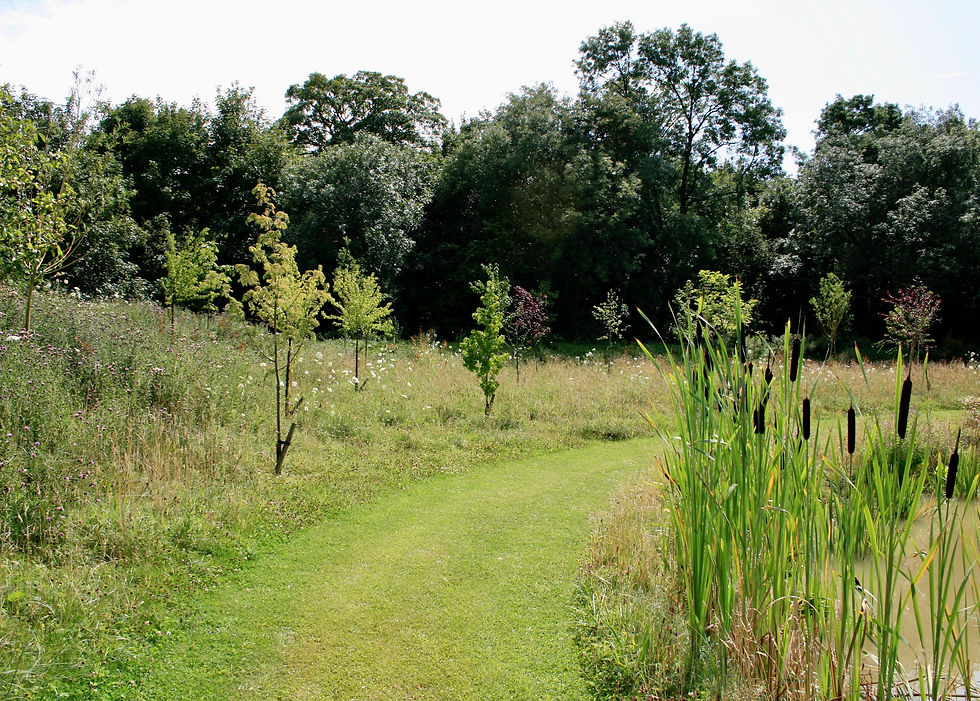
Leaving some (or all!) of our lawns unmown can produce a rich variety of flowers, seed heads and habitats that wouldn’t otherwise be there. Sadly, there a still a few people who see a patch of longer grass as being untidy, but we are slowly seeing an increasing recognition that there is a great deal of beauty in ‘wilder’ spaces. It may be ‘less polished’ but it is so much more valuable. It is often also less demanding from a maintenance perspective.
Gardening with and for nature
The key message is that we have to understand that a successful garden is one that is shared with nature for the benefit of all. We absolutely need to enjoy our green spaces, but a huge part of that can (and should) be enjoying creating habitats, providing sources of food for birds, insects and mammals, and purifying the air that we breathe by filling our gardens with a generous variety of plants. Together we can make a difference.
Tythorne Garden Design provides professional fixed-fee garden design solutions for customers in Grantham, Stamford, Newark and surrounding areas. Let's see how we can help you to enjoy your garden more. Call us on 07900 224 239 or 01529 455 355.